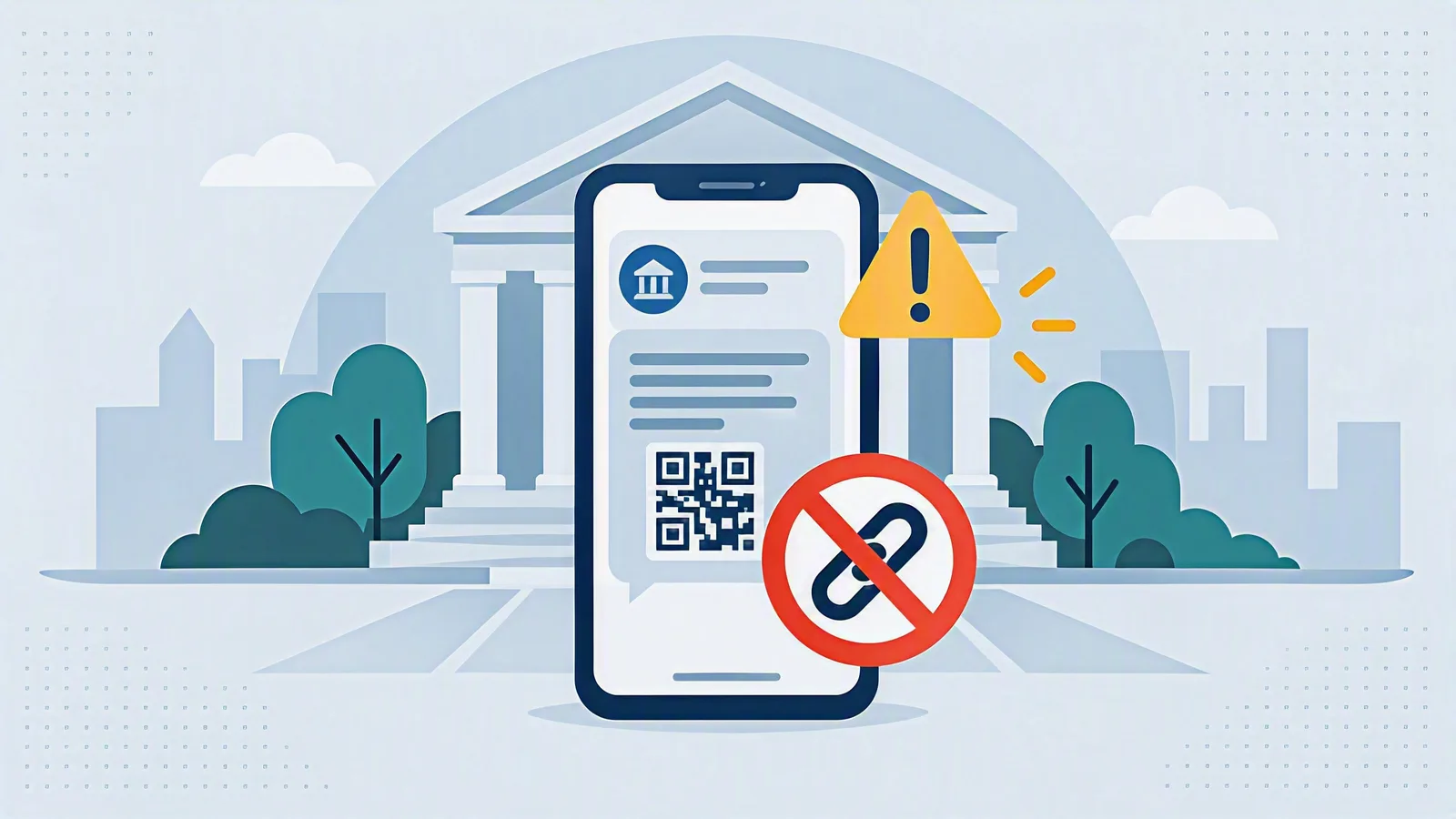
A fake court text and a real one look almost identical, and that is the problem. Across the country in 2025 and 2026, people are receiving text messages claiming they missed a court date, owe a traffic fine, or face an arrest warrant unless they pay immediately, out of the blue, through a link or QR code in the message itself. The messages include a state seal, a case number, a judge’s name, and a hearing date. They are fraudulent. Legitimate courts do send texts, and some let you pay online through an official portal, but they do not cold-text strangers with an urgent pay-now-or-be-arrested ultimatum. Government imposter scams cost Americans about $920 million in reported losses in 2025, up from $789 million the year before. The FBI’s complaint center recorded $797.9 million in government impersonation losses for the year. The corrosive effect extends beyond the people who lose money. Every convincing fake trains the public to treat an official court text as a threat, which is a problem for the courts now using text reminders to keep people out of warrants in the first place.
What the fake looks like
The scam follows a consistent script. A message arrives claiming an outstanding traffic violation or a mandatory court appearance, dressed up with the trappings of authority. The Federal Trade Commission’s own breakdown describes a fake state seal, a fake case number, a scheduled hearing date and time, and a QR code, all paired with urgency: default judgments, fines, and enforcement actions that will supposedly follow if the recipient does not act now. The payment demand is the tell. No court will cold-text a stranger an urgent demand to pay a fine to avoid arrest. If you do have a fine to pay, you use the link on your official court notice or your court’s own website, not one texted to you out of the blue.
The specimens read almost interchangeably from state to state. The Maryland Judiciary warned in April 2026 about texts that referenced a real judge’s name and directed recipients to a specific courthouse on a specific date to pay parking or toll violations. New Hampshire’s Department of Justice reported texts claiming a missed court date or an owed fine, packaged with a fake notice of hearing and, more recently, QR codes linking to fraudulent payment sites. The Pennsylvania Supreme Court has warned of texts that mimicked the court’s website; California’s Attorney General has warned that courts will never text, call, or email to ask for money; and Texas sheriff’s offices and municipal courts have reported fake court texts threatening arrest, license suspension, vehicle impoundment, or asset seizure: different states, one template.
Sophistication is rising. Scammers spoof caller ID, harvest real court staff and judge names from public records, and reuse official-looking case number formats. The Hawaii State Judiciary noted that scammers targeting potential jurors used real official names, real court addresses, spoofed caller ID, and personal details such as a recipient’s name, address, and date of birth. Payment is routed through channels no court uses: gift cards, cryptocurrency, and peer-to-peer apps. In one federal case, scammers demanded payment via Apple Pay, Zelle, Chime, and Venmo. The common thread is a manufactured deadline that pressures recipients to act before they can verify.
This is one template in a much larger wave.
Court impersonation is not a standalone phenomenon. It is one application of a fraud template that has spread across government agencies. The same structure, with an urgent message, a spoofed identity, and a payment demand, drives the fake unpaid-toll texts that the FTC has flagged as spoofing E-ZPass, SunPass, FasTrak, and TxTag; the fake package-delivery texts that prompted a USPS smishing warning; and even impersonation of federal regulators. In August 2026, the Federal Communications Commission warned that scammers were impersonating FCC Commissioners and employees, falsely claiming that a consumer’s phone number was under investigation and demanding payment. Commissioner Anna Gomez confirmed she had been impersonated.
Federal data captures the scale but not the court-specific slice. Neither the FTC’s Consumer Sentinel Network nor the FBI’s Internet Crime Complaint Center breaks out court or jury-duty impersonation as a separate category; both fold it into government impersonation. The data does show a category that is climbing fast. The FBI reported that government impersonation ranked sixth among all crime types by reported loss in 2025, and the FTC reported imposter scams as the most-reported fraud category, with total fraud losses reaching about $16 billion for the year. Two important caveats belong here. The FTC and FBI figures come from different reporting systems and should not be added together. And because neither tracks court impersonation separately, the true court-specific total is not publicly known, which is itself a gap worth naming.
The real cost is trust.
The direct financial loss is the visible harm. The structural harm is quieter and, for courts, more consequential. Each fake court text teaches its recipient a lesson: a message claiming to be from the court, arriving on your phone, is likely a scam. That lesson is rational for the fakes and corrosive for the real thing.
Courts are adopting text reminders precisely because they work. A 2023 meta-analysis in Criminology and Public Policy, synthesizing twelve studies, found that reminders significantly reduced failure-to-appear rates. A 2025 randomized controlled trial published in Science Advances found that automated reminders to public defender clients in Santa Clara County reduced warrants for missed court dates by roughly 20 percent and cut pretrial incarceration by a similar amount. A missed court date is not a small thing. It can trigger a bench warrant, an arrest at a traffic stop, and jail time, exactly the cascade a reminder is designed to prevent. When someone deletes a legitimate reminder because it pattern-matches a scam, the cost isn’t measured in dollars. It is measured in a warrant that a text was supposed to head off.
The courts running legitimate programs are already feeling the interference. The Colorado Judicial Branch, which sends real court-date text reminders statewide, has had to publish a fraud warning stating that the court does send text reminders but will never demand payment by text, and that scam texts use a fake, generic court name and a bogus case-number format. It is not alone. The Superior Court of Los Angeles County built a dedicated Scam Alert page and “Scam Library” to reassure users of its traffic-alert system that the court’s real notifications had not been compromised. Santa Cruz posts scam disclaimers directly alongside its reminder sign-up. Oregon’s courts have had to clarify that they text jury notices and reminders but will never request money. When a legitimate government service has to lead with proof that it is not a fraud, the fraud is already winning. The correlation between scam prevalence and public skepticism toward court messaging is evident in these warnings themselves. However, no public study has yet measured how much a local scam wave depresses enrollment or response rates in a legitimate program, another gap worth flagging.
Why the fix is design, not warning
The instinct is to fight the scam with more warnings. Warnings help, but they put the burden on the public to distinguish a good text from a bad one amid manufactured urgency, exactly the condition under which people fail. The durable answer is structural. It lies in how legitimate court messaging is built, verified, and made recognizable, so that the real message carries signals a scammer cannot easily fake and the public has a simple, reliable way to tell the difference.
That is the subject of the next post: the practical steps a court can take at launch, borrowed from agencies like the IRS and the toll authorities, to tell the public plainly what a real court message looks like, so the next fake has nowhere to land. As one federal court put it in a recent advisory, most contact from real court staff comes through the mail or verified channels, and federal officials do not demand payment to avoid arrest. The scammers have poisoned the well. The task now is to make the clean water recognizable.
Sources
Federal Trade Commission, “FTC Data Show People Reported Losing $3.5 Billion to Imposter Scams in 2025,” June 15, 2026 (primary): https://www.ftc.gov/news-events/news/press-releases/2026/06/ftc-data-show-people-reported-losing-3-point-5-billion-imposter-scams-2025.
Federal Bureau of Investigation, Internet Crime Complaint Center, 2025 Internet Crime Report (primary): https://www.ic3.gov/AnnualReport/Reports/2025_IC3Report.pdf
Federal Trade Commission, “That text about a traffic violation is probably a scam,” April 14, 2026 (primary): https://consumer.ftc.gov/consumer-alerts/2026/04/text-about-traffic-violation-probably-scam
Federal Trade Commission, “New trends in reports of imposter scams,” May 2026 (primary): https://consumer.ftc.gov/consumer-alerts/2026/05/new-trends-reports-imposter-scams
Maryland Judiciary, “SCAM ALERT: Maryland Judiciary warns of text scams about parking and toll violations in Baltimore City District Court,” April 1, 2026 (primary): https://www.courts.state.md.us/media/news/2026/pr20260401
Unified Judicial System of Pennsylvania, “Pennsylvania Supreme Court Warns of Reported Text Message Scam” (primary): https://www.pacourts.us/news-and-statistics/news/news-detail/1277/pennsylvania-supreme-court-warns-of-reported-text-message-scam
New Hampshire Department of Justice, “Consumer Alert: New Scam Text Messages Impersonating NH Courts, Now Using QR Codes,” April 2026 (primary): https://www.doj.nh.gov/news-and-media/consumer-alert-new-scam-text-messages-impersonating-nh-courts-now-using-qr-codes
Hawaii State Judiciary, “Hawaii State Judiciary Warns Public About Jury Duty Scams,” August 13, 2025 (primary): https://www.courts.state.hi.us/news_and_reports/2025/08/hawai%CA%BBi-state-judiciary-warns-public-about-jury-duty-scams
California Office of the Attorney General, “Attorney General Bonta Warns Californians of Court Notice Scams,” March 30, 2026 (primary): https://www.oag.ca.gov/news/press-releases/pay-you%E2%80%99re-trouble-attorney-general-bonta-warns-californians-court-notice-scams
Colorado Judicial Branch, “Fraudulent court appearance text messages targeting Colorado residents” (primary): https://www.coloradojudicial.gov/fraudulent-court-appearance-text-messages-targeting-colorado-residents
Superior Court of Los Angeles County, “Warning of Traffic Alert Scam,” April 2, 2026 (primary): https://www.lacourt.org/newsmedia/uploads/142026429235326PN4-2-2026TrafficAlertScam.pdf
Superior Court of California, County of Santa Cruz, “Court Reminder Notifications” (primary): https://www.santacruz.courts.ca.gov/online-services/court-reminder-notifications
U.S. District Court for the District of Oregon, “Warning: Be Aware of Phishing Scams Related to Court Business, Including Jury Service and Warrants” (primary): https://ord.uscourts.gov/index.php/announcements/1406-advisories/2209-warning-be-aware-of-court-related-phishing-scams
Oregon Judicial Department, “Scam Alerts” (primary): https://www.courts.oregon.gov/how/pages/id-theft.aspx
U.S. District Court for the Southern District of Georgia, “Georgians Targeted with Scams re: Jury Duty, Fake Arrest Warrants, and Other Spoofed Documents,” March 27, 2024 (primary): https://www.gasd.uscourts.gov/news/georgians-targeted-scams-re-jury-duty-fake-arrest-warrants-and-other-spoofed-documents
Federal Communications Commission, “Alert: Beware of Scammers Impersonating FCC Commissioners and Employees,” August 10, 2026 (primary): https://www.fcc.gov/document/alert-beware-scammers-impersonating-fcc-commissioners-employees
U.S. Postal Inspection Service, “Smishing: Package Tracking Text Scams” (primary): https://www.uspis.gov/news/scam-article/smishing-package-tracking-text-scams
Chohlas-Wood, Coots, Nudell, Nyarko, Brunskill, Rogers, and Goel, “Automated reminders reduce incarceration for missed court dates: Evidence from a text message experiment,” Science Advances, Vol. 11, eadx7483, October 1, 2025 (primary): https://www.science.org/doi/10.1126/sciadv.adx7483
eCourtDate blog, “What Actually Works: The Science of Getting People to Court” (secondary, publisher’s own): https://blog.ecourtdate.com/what-actually-works-the-science-of-getting-people-to-court