In the previous post, we established that prevention costs $9.84 per failure to appear, while enforcement costs $2,850—a 290-to-1 return on investment. The data settled that question years ago.
So why do half of the U.S. states still not use court reminders?
Part of the answer is that courts don’t know what good implementation looks like. They’ve heard that reminders work, but they don’t know which design choices matter. Should messages go out three days before court or seven days? Does wording make a difference? Text or phone call?
The research answers all of these questions. And the answers are surprisingly specific.
New York City tested this on 800,000 summonses.
The landmark study was conducted in New York City in 2020. Researchers partnered with the city to test court reminders on more than 800,000 summonses for low-level offenses.
They started by sending people a text reminder. Failure-to-appear rates dropped 21%.
Then they revised the message wording. The reduction jumped to 26%.
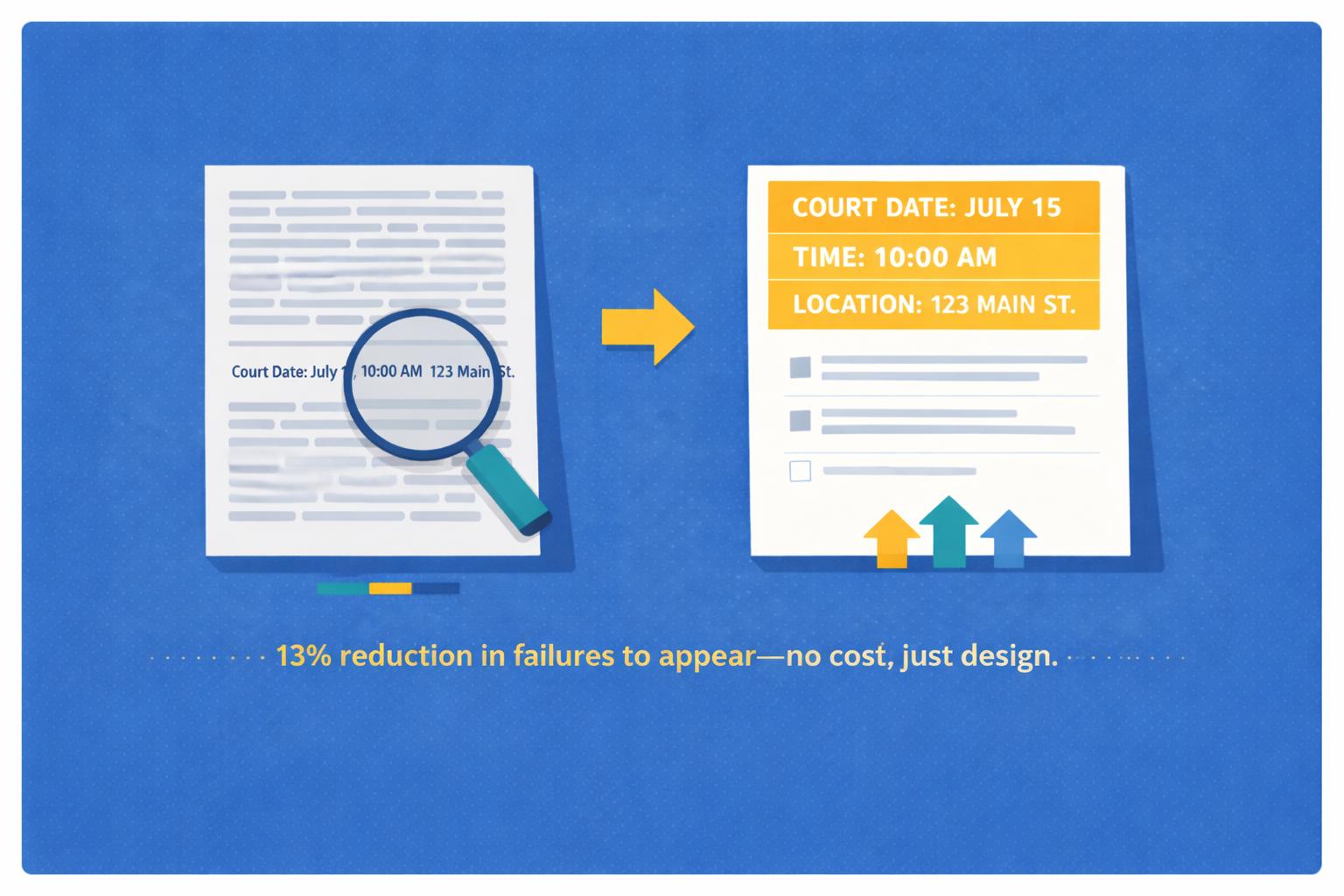
They also redesigned the court summons form, moving the court date and time to the top rather than burying them under other information—the result: a 36% reduction in failures to appear.
That’s 30,000 fewer arrest warrants over three years, for less than $7,500 per year.
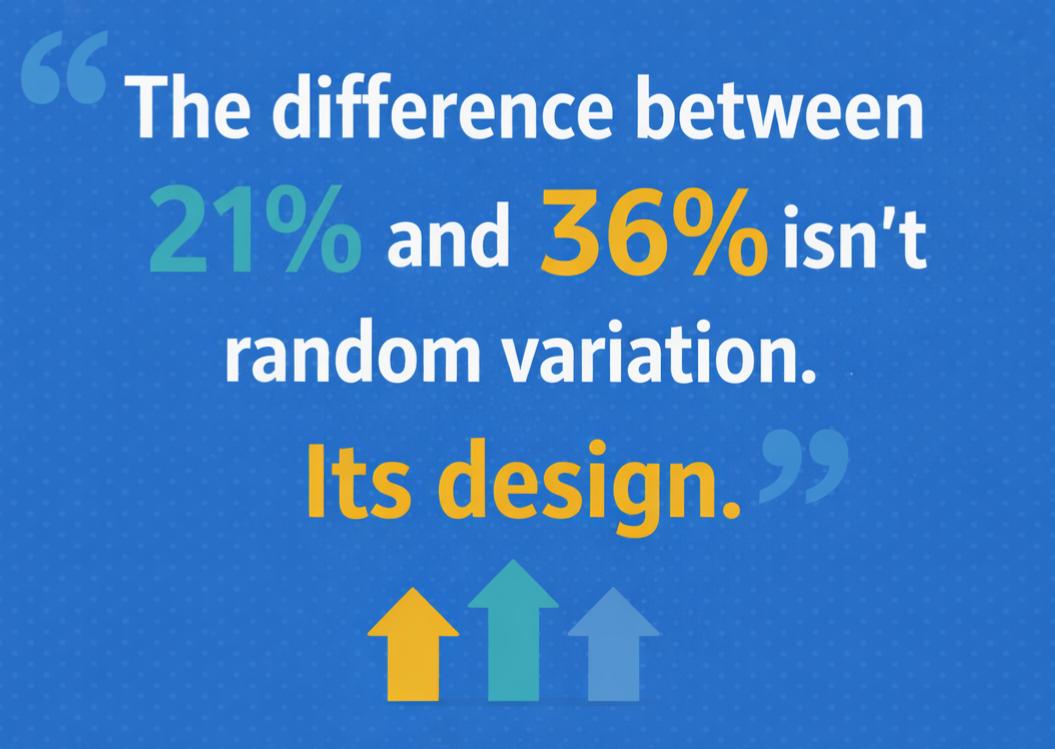
The difference between 21% and 36% isn’t random variation. Its design.
What you say in the message matters.
Nebraska ran a 14-county study with 7,865 defendants to test different message types.
Three groups:
- No reminder: 12.6% failed to appear
- Simple reminder (“You have court on [date] “): 10.9% failed to appear
- Loss-framed consequences (“If you miss court, a warrant will be issued for your arrest “): 8.3% failed to appear
The consequences message reduced failure-to-appear rates by 34% compared to the no-contact control.
But researchers found something even more effective: plan-making prompts.
The most successful message in the NYC study asked: “What time should you leave to get to court?”
That simple question forces people to think through logistics, including transportation, childcare, and the time needed. It converts a vague intention (“I’ll go to court”) into a concrete plan (“I need to leave by 9:15 a.m.”).
Messages that combined plan-making prompts with consequence warnings achieved 26% reductions. Consequences alone: 19%.
The wording isn’t decoration. It’s the intervention.
Where information appears on the form matters.
Before New York City tested text reminders, it tested something simpler: form redesign.
The original summons buried the court date, time, and location under other text. People had to hunt for it. Many didn’t find it. Some who did found it hard to understand.
The redesigned form places the date, time, and location at the top, in bold, prominent type that’s impossible to miss.
That change alone reduced failure-to-appear rates by 13%.
When combined with text reminders, the total reduction reached 36%.
Courts spend thousands of hours processing missed appearances. A form redesign costs nothing. Yet most courts haven’t done it.
Most people don’t know reminder systems exist.
Here’s the problem with opt-in programs.
Lake County, Illinois, implemented an automated court reminder system through its public defender’s office. Text messages with court date, time, and location. Free. Voluntary.
Researchers interviewed people who had missed court and had bench warrants issued for their arrest.
They asked: Did you know this reminder system existed?
- 90% said no. They asked: If you had known about it, would you have enrolled?
- 90% said yes. They asked: Would you be comfortable with automatic enrollment (with the option to opt out)?
- 97% said yes. The system worked. People wanted it. But they didn’t know it existed, so they couldn’t opt in.
This isn’t unique to Lake County. Pew’s 2025 survey found that nearly half of U.S. states don’t offer court reminders at all. Of the states that do, many require manual opt-in.
Behavioral evidence shows the impact: opt-out programs increase appearance rates by 20-30%, while opt-in programs produce lower participation and exacerbate equity gaps.
Participation rates tell the story:
- Opt-in programs: Low participation, people are unaware they exist
- Arizona (automatic enrollment): 72% participation
- New Mexico (automatic enrollment): 90% participation
Colorado switched from opt-in to automatic enrollment in 2022. Failure-to-appear rates dropped by 30%. The number of reminders sent jumped from 56,000 to 224,000 per month—a 300% increase in reach.
The difference isn’t the technology. It’s the enrollment design.
Courts concerned about legal compliance and opt-out procedures can learn more in our detailed analysis: Opt-In Compliance for Court Text Messaging: Balancing Law, Access, and Administrative Practice.
Timing matters less than you’d think.
Courts often ask: When should we send reminders? How far in advance?
Research converges on a standard schedule: messages at 7, 3, and 1 days before the court date.
But a 2022 NYC study tested timing directly. Same-day phone calls performed just as well as calls made three days in advance. The difference wasn’t statistically significant.
The key finding: any well-designed reminder outperforms no reminder, regardless of specific timing.
Implementation quality matters more than timing precision.
Not everything works for everyone.
Text reminders work for most people, but not all.
A randomized trial in Shasta County, California, found that text reminders were completely ineffective for homeless defendants.
Only 35% of texts sent to homeless individuals were successfully delivered, compared to 55% for housed residents. Even among homeless defendants who received texts, there was no significant reduction in missed court dates.
The reasons are straightforward: no stable phone number, no way to charge a phone, and no reliable access to check messages.
Text reminders address one barrier: forgetting. They don’t address transportation, housing instability, or resource shortages.
This matters because people experiencing homelessness are 11 times more likely to be arrested than housed individuals. In Austin, Texas, nearly 60% of citations for homeless-related offenses resulted in bench warrants.
The population most likely to miss court is the population least likely to benefit from standard text reminder systems.
Solutions for this group require different interventions: in-person outreach, transportation assistance, and specialized court programs. San Diego’s Homeless Court processed 4,226 cases in 2018, with 96% resolved in one hearing.
The highest reductions come from bundled approaches.
Tennessee implemented SMS reminders plus personalized assistance for people who needed help getting to court. Failure-to-appear reduction: 39%. The highest in any published study.
New York City combined form redesign with text reminders, resulting in a 36% reduction.
Nebraska combined consequences messaging with postcards, resulting in a 34% reduction.
Single interventions work. But bundled approaches work better.
The most effective programs don’t just remind people about court. They make it easier to get there.
Why programs fail.
Not all reminder programs succeed. Some produce no measurable effect.
A UK study in Staffordshire found that text reminders did not affect witness attendance. 76% with reminders versus 78% without. Not statistically significant.
What separates successful programs from failed ones?
Implementation quality.
A 2023 meta-analysis of 12 studies with 79,255 participants found that reminder format (text, phone, postcard) didn’t systematically affect results. What mattered: message design, enrollment strategy, and target population.
Programs fail when:
- They use opt-in enrollment and don’t promote it
- Messages provide information, but no consequences or plan-making prompts
- They assume text works for everyone, including unstably housed populations
- Forms remain poorly designed, even with reminders added
Programs succeed when:
- They use automatic enrollment (opt-out instead of opt-in)
- Messages combine plan-making prompts with consequences
- Forms are redesigned to make date/time/location prominent
- They recognize that reminders address forgetting, not structural barriers
What this means for courts
The research is detailed and specific.
- Message design: Loss-framed consequences (“If you miss court, a warrant will be issued”) reduce failures to appear. Plan-making prompts (“What time should you leave?”) work even better. Generic reminders (“You have court tomorrow”) work, but not as well.
- Form design: Court date, time, and location must be prominent. Put them at the top, bold, impossible to miss. NYC’s form redesign alone produced 13% reductions.
- Enrollment strategy: Automatic enrollment with opt-out generates 72-90% participation and increases appearance rates by 20-30%. Opt-in programs produce low participation because most people don’t know they exist.
- Bundled interventions: Tennessee’s 39% reduction came from reminders plus personalized assistance. Single interventions work. Multiple interventions work better.
- Equity considerations: Text reminders fail homeless populations. Only 35% of texts reach homeless defendants, and delivery doesn’t improve outcomes. This population requires in-person outreach and transportation assistance.
- Implementation quality matters more than format: Whether courts use text, phone, or postcard matters less than whether they use automatic enrollment, well-designed messages, and redesigned forms.
The question isn’t whether reminder systems work. The data settled that.
The question is whether courts will implement them correctly.
What’s next?
This series has examined the scale of the U.S. court system, the cascading effects of failures to appear, why communication breakdowns cause most missed court dates, what all of this costs, and now what actually works.
The final post will address the elephant in the room: text message scams that impersonate courts. Fraudulent messages undermine public trust in legitimate reminder systems. Courts need to know how to protect their communications and their communities.
Sources
All sources are publicly available research, not behind paywalls:
Behavioral Science and Message Design
- Fishbane, Ouss, and Shah, “Behavioral nudges reduce failure to appear for court,” Science (2020)
- Bornstein et al., “Reducing courts’ failure-to-appear rate by written reminders,” Psychology, Public Policy, and Law (2013)
- ideas42, “Smart Court Appearance Strategies: Court Date Reminders” (April 2024)
- ideas42, “Improving Court Attendance: The Essential Guide to Court Reminder Programs” (2025)
Meta-Analysis and Systematic Review
- Zottola et al., “Court date reminders reduce court nonappearance: A meta-analysis,” Criminology & Public Policy (2023)
Randomized Controlled Trials
- Chohlas-Wood et al., “Automated reminders reduce incarceration for missed court dates,” Science Advances (October 2025)
- Owens, Emily, and CarlyWill Sloan, “Can Text Messages Reduce Incarceration in Rural and Vulnerable Populations?” Public Administration and Management (2023)
Automatic Enrollment Research
- The Pew Charitable Trusts, “States Underuse Court Date Reminders” (May 2025)
- The Pew Charitable Trusts, “Investments in Text Reminders Bring State Courts Big Gains” (January 2026)
- Russell, Michelle, “Report: Text reminders for court hearings can help boost justice system efficiency,” Route Fifty (May 2025)
Vulnerable Populations and Equity
- Vera Institute of Justice, “No Access to Justice: Breaking the Cycle of Homelessness and Jail” (2020)
- J-PAL Poverty Action Lab, “Using simple reminders to reduce failures to appear in court.”
Form Design and Court Notifications
- NYC Criminal Justice Agency, “Court Date Notifications: A Summary of the Research and Best Practices” (2021)