Recap of Part 1 and Part 2
This is Part 3 of the series. In Part 1, we covered significant research showing that reminders decrease missed court dates and promote fairness. In Part 2, we examined why implementation is challenging in government settings characterized by limited resources, legacy systems, and complex workflows.
You can read Part 1 and Part 2 here.
Now we focus on solutions.
A Better Model for Modernization
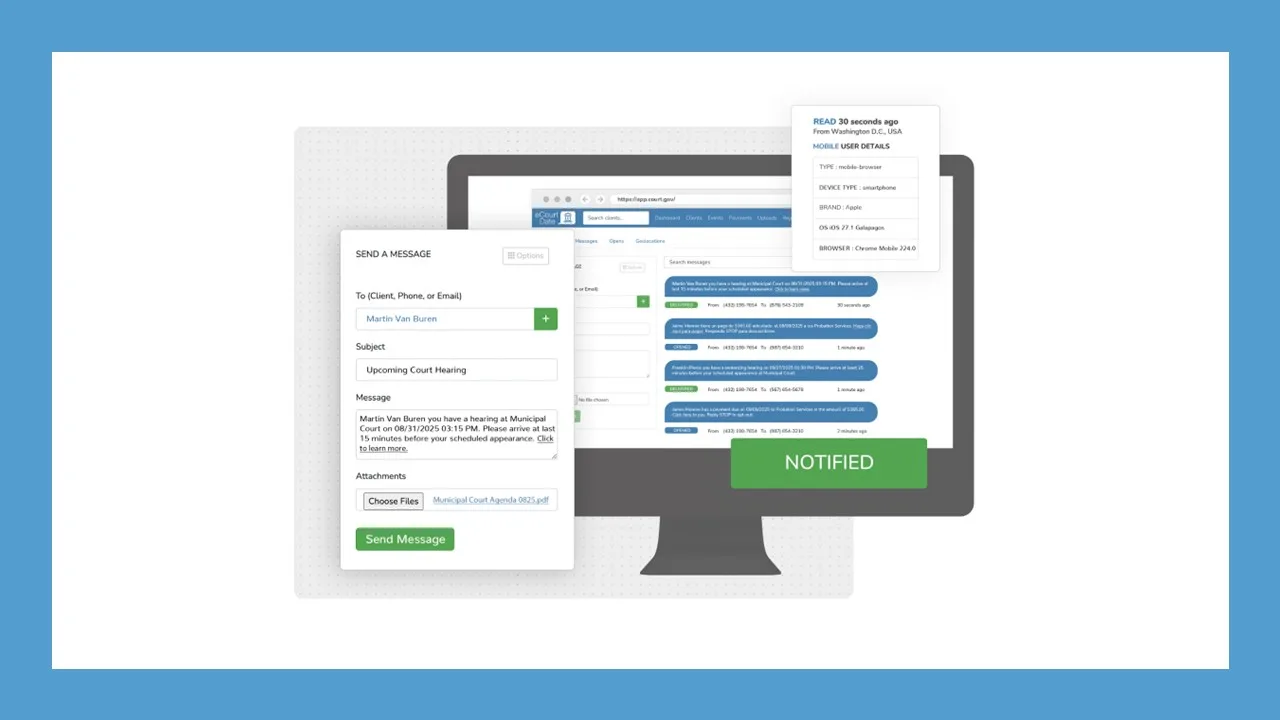
Ideas42 identifies three approaches to reminder systems: CMS add-ons, DIY builds, and specialty communications platforms. The third option delivers the strongest results because it reduces staff burden and provides complete features out of the box. eCourtDate follows this model. The Essential Guide notes that modern platforms must support automatic enrollment, multilingual messaging, flexible delivery channels, staff-friendly dashboards, and repeated reminders. These features are integrated into eCourtDate from day one.
The National League of Cities emphasizes that effective digital services should be user-focused, accessible, and customized to residents' needs. eCourtDate's multilingual, mobile-friendly reminders and self-service tools directly support these principles.
The National Center for State Courts suggests that digital communication tools are most effective when courts use plain language, consistent timing, and accessible channels. eCourtDate's templates, translations, and behavioral messaging follow these principles and mirror the communication styles people already use daily.
The Effective Communications fact sheet shows that reminders reduce missed appointments by more than one-third when combined with clear forms and timely outreach. eCourtDate incorporates these evidence-based practices directly into the product, without requiring counties to create their own materials or workflows.
Removing the Friction That Slows Change
Most importantly, eCourtDate reduces barriers that slow modernization. The platform is cloud-based, so counties don't need to install or maintain anything. Integrations use standard methods IT teams already know. Setup takes days or weeks, not months. Templates and schedules are prebuilt. Multilingual support is automatic. Training is simple and repeatable.
Counties don't have to redesign processes from scratch. They can start small, show results, and grow as needed. This makes modernization possible even for agencies with limited staff or tight schedules.
A Personal Reflection on Change
Throughout my work in city government, a district attorney's office, and the courts, implementation was almost always the most challenging step. Not every project succeeded on the first try, and some needed multiple attempts. However, I never regretted striving to improve the system. The worst outcome was having to revert to the old workflow. The best outcomes led to lasting improvements for the public and the staff who serve them. That same principle holds true for court reminders today.
Modernization doesn't have to overwhelm staff. A partner who understands government constraints can handle the complexity, so counties don't have to.
Change is hard. Court notifications are not the problem. With the right partner, counties can quickly modernize, improve appearance rates, lessen workload, and serve the public better.
Sources for Part 3
• Ideas42 Essential Guide to Court Reminder Programs
https://www.ideas42.org/wp-content/uploads/2025/05/i42-1530_RemindersRpt_Final.pdf
• Ideas42 Effective Communications Fact Sheet
https://www.ideas42.org/wp-content/uploads/2023/07/Effective-Communications-to-Increase-Court-Appearances_Fact-Sheet.pdf
• NCSC Trends in State Courts 2025
https://www.ncsc.org/sites/default/files/media/document/NCSC-Trends-2025.pdf
• NLC Municipal Digital Services Action Guide
https://www.nlc.org/resource/building-innovative-digital-services-municipal-action-guide/
• Pew Charitable Trusts, "States Underuse Court Date Reminders," 2025
https://www.pew.org/en/research-and-analysis/issue-briefs/2025/05/states-underuse-court-date-reminders