Public debates about the justice system often focus on high-profile criminal cases or sweeping policy reforms. What is discussed far less frequently is the scale and composition of the court system itself. Without that context, it is easy to misunderstand where courts spend their time, why failures occur, and which problems are actually solvable.
The data tells a clear story. The U.S. court system is vast, highly decentralized, and dominated by high-volume, low-level cases. Many of the most visible problems, including failures to appear, outstanding warrants, and short-term jail churn, are not edge cases. They are structural features of how courts operate at scale.
This article draws on the most reliable national data to establish a baseline. The goal is not advocacy. It is orientation. Understanding the numbers is a prerequisite to understanding what courts can realistically improve.
The scale of the U.S. court system
According to data from the National Center for State Courts, state and local courts handle roughly 66 million cases each year, accounting for about 98 percent of all court filings in the United States. By comparison, federal courts process well under one million matters annually.
This distinction matters. When people talk about "the court system," they are almost always referring to state and local courts, even if they do not realize it. These courts handle everything from traffic tickets and evictions to misdemeanors, felonies, family law, and probate.
Court filings declined sharply during the COVID-19 pandemic and have only partially rebounded. Even so, recent figures still place annual state court filings at around 70 million. The system is smaller than it was a decade ago, yet it remains one of the largest administrative systems in the country.
What kinds of cases do courts handle?
Trials and serious criminal prosecutions shape the popular image of courts. The data, however, paints a very different picture.
According to analysis by the Pew Charitable Trusts, about 57 percent of state court cases involve traffic or local ordinance violations, most of which are non-criminal infractions. Another 20 percent are civil matters, including debt collection, landlord-tenant cases, and small claims. Criminal cases account for roughly 17 percent of filings, with the remainder primarily family law matters.
In practical terms, this means that most court activity involves low-level cases that move quickly and at high volume. These cases rarely involve juries, lengthy trials, or incarceration for serious offenses. They do, however, require that people receive notice, understand instructions, and appear in court or resolve matters administratively.
This case mix has critical downstream effects. Systems designed for high-volume, low-severity cases behave very differently from those optimized for rare, high-stakes litigation.
Failures to appear are common and unevenly distributed
A failure to appear occurs when a person does not show up for a required court date. Depending on the jurisdiction, this can result in a bench warrant, license suspension, or other penalties.
Research synthesized by Pew, the Urban Institute, and state court administrators shows that between 15 and 25 percent of defendants in many jurisdictions miss at least one required court appearance. The rate varies widely by case type.
More serious charges are associated with higher appearance rates. Lower-level cases are associated with significantly higher failure-to-appear rates. In New York City, public court data has shown failure-to-appear rates approaching 40 percent for criminal summonses, compared with much lower rates for felony cases.
This pattern is consistent across jurisdictions. It suggests that failures to appear are not primarily driven by attempts to flee serious prosecution. They are far more common in cases involving minor offenses, confusing paperwork, long delays, or low perceived stakes.
Outstanding warrants are a volume problem, not a rarity
When a court issues a bench warrant for failure to appear, that warrant often remains active until it is resolved. Over time, this results in significant backlogs.
Based on analyses compiled by court audits and national research organizations, the United States has millions of outstanding warrants at any given time. Recent estimates place the number between 7 and 10 million, with the majority tied to missed court dates or unpaid fines rather than new criminal conduct.
Importantly, these figures do not represent an equal number of people. Many individuals have multiple warrants, often accumulated through repeated missed appearances in low-level cases. Local audits routinely find that a small number of individuals account for a disproportionately large share of outstanding warrants.
Where jurisdictions have examined warrant composition in detail, the pattern is consistent. Most outstanding warrants are for traffic violations, municipal code violations, or misdemeanors. Felony warrants represent a much smaller share.
Warrant enforcement consumes real resources
Outstanding warrants are not merely administrative records. They drive enforcement activity.
Research by the Data Collaborative for Justice analyzing arrests in Louisville, Kentucky, and St. Louis, Missouri, found that in some cities, 10 to 15 percent of all arrests are warrant-only arrests, meaning the person was taken into custody solely because of an outstanding warrant and not because of a new offense.
In both cities, a majority of warrant-only arrests stemmed from non-felony conduct, including municipal ordinance violations and misdemeanors. This enforcement pattern consumes police time, court staff time, and jail capacity, often without addressing the underlying issue that led to the warrant being issued in the first place.
Administrative failures often drive jail churn
According to national jail data collected through the Bureau of Justice Statistics Annual Survey of Jails, roughly 70 percent of people held in local jails are legally presumed innocent and awaiting trial on any given day.
A meaningful share of jail admissions are linked to warrants and failures to appear. Local studies have found that people jailed for failure to appear often spend days or weeks in custody before seeing a judge, even when the underlying case is minor. These short stays are disruptive for individuals and costly for counties, yet they are rarely the result of new criminal behavior.
Because these costs are spread across multiple agencies, courts rarely see the full downstream impact of missed appearances. As a result, the system reacts to failure rather than preventing it.
What the numbers suggest about solutions
The data does not support the idea that all court problems are fixable. Courts cannot eliminate poverty, housing instability, or transportation barriers. They can, however, influence how clearly they communicate and how easily people can comply.
Across jurisdictions, one category of intervention stands out for its consistency: proactive court communication, particularly reminder systems. Research summarized by Pew and the Urban Institute shows that well-designed reminders reduce failures to appear by 10 to 30 percent, particularly in high-volume, low-level cases.
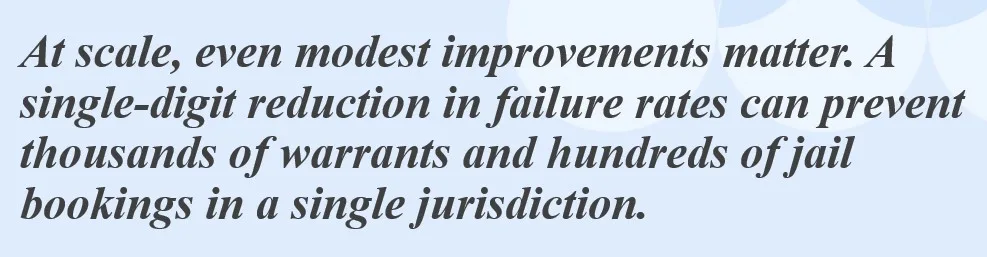
At scale, even modest improvements matter. A single-digit reduction in failure rates can prevent thousands of warrants and hundreds of jail bookings in a single jurisdiction. This is why communication and reminder infrastructure have emerged as one of the few improvements that reliably deliver measurable results without expanding enforcement.
Why this baseline matters
Debates about courts often jump straight to policy prescriptions. The numbers suggest a different starting point.
The U.S. court system is not dominated by violent crime or complex litigation. It is dominated by volume. Many of its most persistent problems arise not from malice or defiance, but from scale, fragmentation, and communication gaps.
Understanding this reality is essential. It clarifies why specific problems persist, why some reforms disappoint, and why investments in basic court communication can have outsized effects.
This article lays the foundation for deeper analysis. Subsequent pieces will examine failures to appear, warrants, enforcement patterns, and communication breakdowns in greater detail. Each builds on the same data. The system only makes sense when viewed as a whole.
Sources and further reading
-
Pew Charitable Trusts, State Courts Play a Key Role in American Life
-
Data Collaborative for Justice, Warrants and Arrests in Louisville, KY and St. Louis, MO (Dec. 2020)