SERIES INTRODUCTION
Courts, cities, and counties understand what works. They recognize that clear communication reduces confusion, boosts engagement, and saves money. They see that digital tools can streamline processes and enhance service delivery. They know residents expect accessible, user-focused digital experiences. This knowledge is not new. Extensive research exists, and best practices are well known.
Yet implementation continues to lag.
This series aims to understand why. My goal is to closely examine the obstacles that slow the adoption of proven practices, especially when those practices promote fairness, reduce workload, and improve outcomes for the public. I want to explore why change is so hard in government settings and how agencies can progress without adding to staff burdens.
The series is organized into three parts.
Part 1 reviews the evidence that court reminders work and explains why adoption lags nationwide.
Part 2 examines the structural challenges that make modernization in government difficult.
Part 3 shows how the right partner can remove these barriers and make implementation practical, predictable, and low lift.
If we can understand the barriers, we can help agencies overcome them.
PART 1: Court Date Reminders Work. So Why Are They Still Underused?
Courts nationwide continue to deal with high rates of missed court appearances. These absences result in warrants, jail bookings, case delays, higher costs, and lost time for judges and staff. Pew Charitable Trusts reports that most states still lack reliable reminder systems, even though missed appearances remain a significant cause of inefficiency and unnecessary incarceration.
The frustrating part is that the solution is proven.
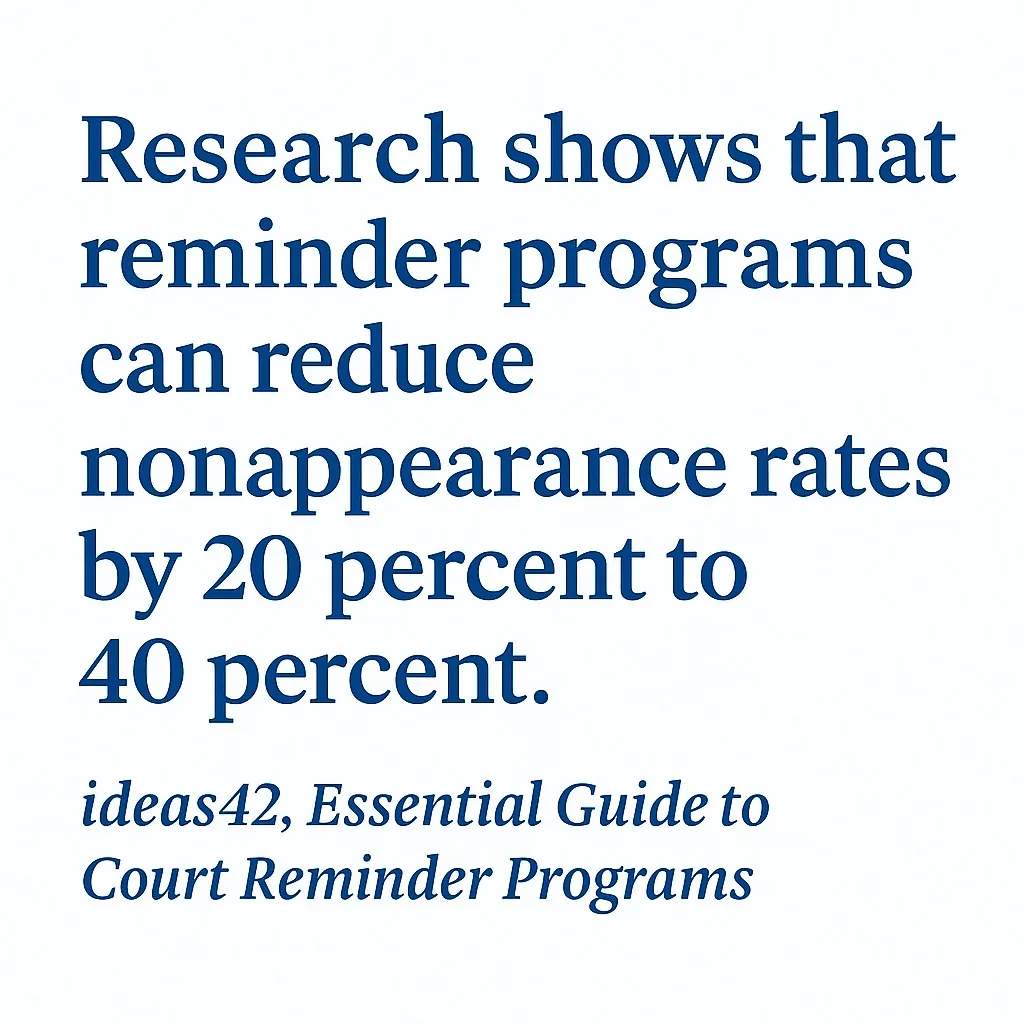
Ideas42's Essential Guide to Court Reminder Programs shows that well-designed court reminders cut missed appearance rates by 20 to 40 percent. Their Effective Communications fact sheet states that behaviorally informed reminders reduce missed criminal court dates by 12.5 percentage points, a 27 percent improvement. In some programs, appearance rates improved by up to 36 percent.
These findings align with research from the National Center for State Courts. NCSC's Trends 2025 report emphasizes that courts adopting user-focused communication practices experience notable increases in appearance rates and trust, especially when notifications are timely, accessible, and clearly written.
The National League of Cities also indicates that residents expect digital service delivery. More than half of Americans prefer digital access to public services, and many cities report rising expectations for mobile-friendly, user-centered communication. When courts use digital communication tools that align with residents' expectations, participation increases.
If the evidence is this strong, why are reminders used so rarely?
Pew's May 2025 report states that only eighteen states have statewide reminder programs. Many counties lack multilingual messaging, while others only send a single reminder or rely on outdated robocalls. Some use opt-in enrollment, which excludes most court participants, while others require staff to enter data because their systems do not integrate well with manual entry.
The challenge is not technology. It is implementation. Courts operate within systems that hinder change. Staff are overwhelmed. IT systems are outdated. Data is scattered. Many processes were created decades ago and have never been updated to match modern communication needs. Even when a reminder system is funded or widely supported, local implementation still takes time, coordination, and effort.
Understanding the gap between evidence and adoption is the first step toward fixing it.
Part 2 will explore why these conditions persist and why even simple improvements require more effort than people realize.
Sources for Part 1
• Pew Charitable Trusts, "States Underuse Court Date Reminders," 2025, https://www.pew.org/en/research-and-analysis/issue-briefs/2025/05/states-underuse-court-date-reminders
• Pew Charitable Trusts, "States Underuse Court Date Reminders Brief," 2025, https://www.pew.org/en/research-and-analysis/issue-briefs/2025/05/states-underuse-court-date-reminders
• Ideas42 Essential Guide to Court Reminder Programs, https://www.ideas42.org/wp-content/uploads/2025/05/i42-1530_RemindersRpt_Final.pdf
• Ideas42 Effective Communications Fact Sheet, https://www.ideas42.org/wp-content/uploads/2023/07/Effective-Communications-to-Increase-Court-Appearances_Fact-Sheet.pdf
• NCSC Trends in State Courts 2025, https://www.ncsc.org/sites/default/files/media/document/NCSC-Trends-2025.pdf
• NLC Municipal Digital Services Action Guide, https://www.nlc.org/resource/building-innovative-digital-services-municipal-action-guide/