In a previous post, we examined why people miss court dates. The evidence is clear: it’s communication breakdowns, not defiance. Court notices get lost, life happens, and 90% of people don’t even know reminder systems exist.
Now let’s talk about what those missed court dates actually cost.
Most courts don’t calculate this number. They should, because when researchers do the math, the results are eye-opening.
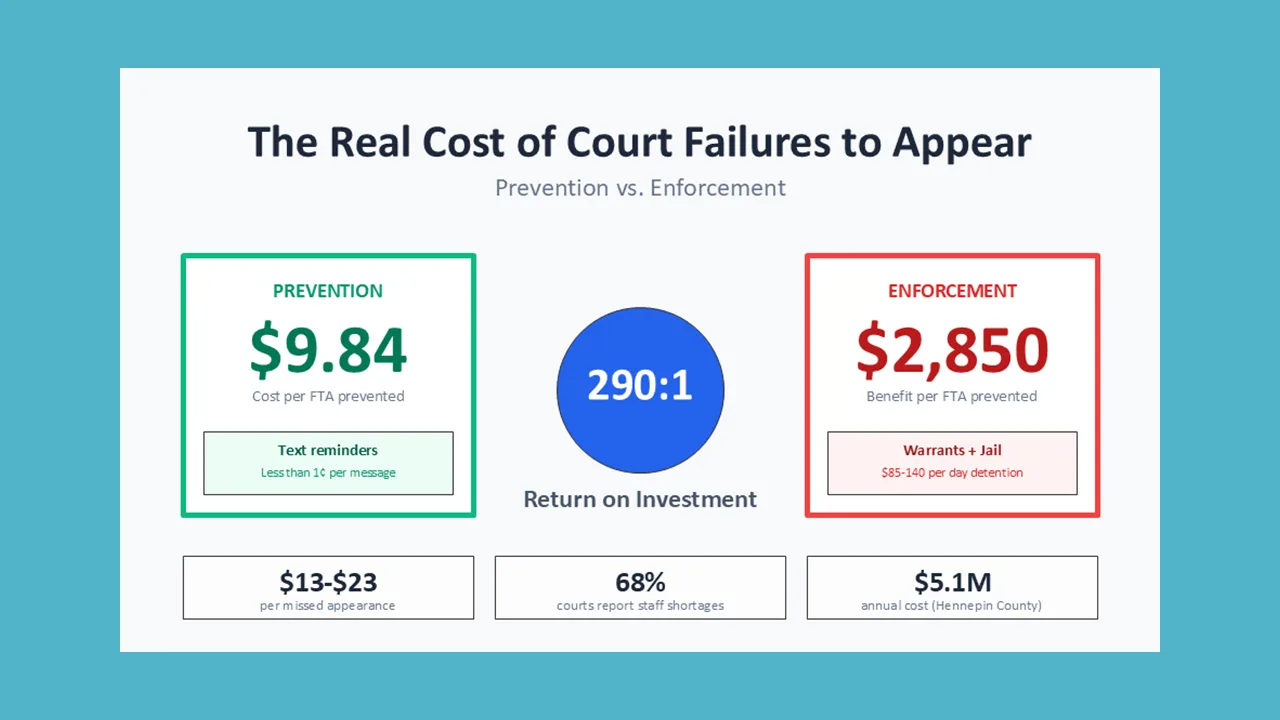
Every missed court date costs courts at least $13 in staff time alone
The National Center for State Courts developed a model to determine what courts actually spend when a party doesn’t appear. They kept it conservative, counting only the minimum staff required: one judge, one clerk, one bailiff, and one court reporter. They assumed only five minutes of hearing time.
The baseline cost: $13 per missed appearance.
That’s just the in-courtroom time. It doesn’t include pulling case files, processing warrant paperwork, issuing notices for the rescheduled hearing, or updating case management systems.
Allocate 10 minutes of clerk time for the follow-up work? The cost jumps to $23 per missed appearance.
Now multiply that across thousands of cases. A mid-sized jurisdiction that processes 11,250 missed appearances annually spends more than $260,000 on this problem.
Remember, that’s the conservative estimate. Many courts need interpreters, extra security, or spend more than five minutes per case. The real number is almost certainly higher.
Court time costs about $40 per minute
Here’s another way to think about it.
The National Center for State Courts calculated the average operating cost of a state courthouse at roughly $40 per minute during regular business hours. That includes salaries, benefits, facilities, technology, and overhead.
Every minute spent processing a missed appearance is a minute unavailable for productive work. Staff can’t help other litigants. They can’t clear backlogs. They can’t improve services.
The missed appearance leaves the case unresolved. The case remains open. The problem remains unsolved. The only output is a warrant and another court date, which carries its own risk of being missed.
Courts operating near capacity can’t accommodate thousands of additional hearings without consequences.
Staff are burning out, and it’s expensive
Here’s what often gets overlooked: the human cost.
A 2025 survey found that 68% of courts report staff shortages. High turnover. Not enough applicants. Positions sit empty.
Replacing a single court clerk costs between $22,000 and $91,000, depending on recruitment expenses and training time. When experienced employees leave, courts lose institutional knowledge that took years to build.
What’s driving people out the door? Low pay, limited flexibility, and burnout.
And missed appearances make burnout worse. The work is repetitive. Issue the same documents. Process the same warrants. Reschedule the same hearings. Over and over.
Court staff have reported sleep loss due to filing backlogs. Some say it affects their health.
Poor morale isn’t just an HR problem. Gallup estimates that disengaged employees cost more than $1 trillion in annual lost productivity across all sectors. Courts aren’t immune.
The costs don’t stop at the courthouse door.
When courts issue bench warrants for missed appearances, someone must execute them.
Police officers typically spend 2 to 4 hours making an arrest and completing the booking process. In North Carolina, 16% of the jail population consists of people detained for failing to appear. That’s law enforcement time spent on warrant enforcement instead of responding to new crimes.
Let’s look at what a few jurisdictions actually spend:
Tulsa County, Oklahoma: $1.2 million per year for jailing people for FTAs. Average stay: 15 days.
Hennepin County, Minnesota: Over $5.1 million annually on the same issue. Researchers estimated that reducing bench warrants by 35% would save $3.1 million annually.
Colorado: Issued more than 216,000 bench warrants over five years. Just for traffic violations.
Most of these people aren’t dangerous. They’re not flight risks. They miss a court date, often for a minor offense. They sit in jail for days or weeks, then are released with a new court date.
The jail time serves no purpose except temporary detention. The underlying case remains unresolved.
Prevention costs pennies compared to enforcement
Now here’s where it gets interesting.
The A2J Lab calculated the cost of implementing court reminder programs in 2025 to be $9.84 per failure-to-appear prevented.
The benefit of each prevented FTA is $2,850 in avoided costs.
That’s a 290-to-1 return on investment.
Research published by Pew and ideas42 in January 2026 found that statewide reminder programs cost less than a penny per text message and less than 50 cents per eligible case.
A randomized controlled trial in Santa Clara County (published in Science Advances in October 2025) tested this with 5,709 people. Half received text reminders. Half didn’t.
Results:
- Warrants dropped 20% (from 12.1% to 9.7%)
- Incarceration for missed court dates fell from 6.6% to 5.2%
New York City’s reminder program prevented an estimated 30,000 warrants over three years—annual cost: less than $7,500 for the entire city.
Compare that to enforcement:
The Brennan Center found that governments spend 41 cents on every dollar collected through criminal justice fees and fines. One New Mexico county spent $1.17 to collect every dollar. They lost money on enforcement.
Multnomah County, Oregon, documented warrant execution costs at $1,320 per warrant.
Jail costs run $85 to $140 per day, depending on the jurisdiction.
Prevention: pennies. Enforcement: hundreds or thousands of dollars.
The math isn’t close.
So why don’t more courts use reminders?
Good question.
A 2025 Pew survey found that nearly half of U.S. states don’t offer court date reminders at all.
Of the states that do, many require people to opt in manually. That produces terrible participation rates.
Arizona uses automatic enrollment (people can opt out if they want)—participation rate: 72%.
New Mexico does the same—participation: 90%.
Colorado switched from opt-in to opt-out in 2022. Failure-to-appear rates declined by 30%.
The design matters as much as the program’s existence.
Part of the problem is structural. Court budgets fund enforcement by default, covering the salaries of judges, clerks, and bailiffs, as well as the maintenance of courtrooms. When someone fails to appear, that infrastructure kicks in automatically. Warrants are issued. Arrests are made. Jails accept bookings.
Prevention infrastructure requires intentional investment. Courts must build or buy reminder systems, integrate them with case management software, train staff, and allocate ongoing resources.
There’s also a visibility problem. Courts see the consequences of missed appearances every day. Judges call cases that go unanswered, and clerks process warrants. These activities are routine and obvious.
What courts don’t see: the thousands of court dates that didn’t get missed because someone received a reminder. Prevention is invisible when it works.
Finally, there’s institutional inertia. Many court systems were designed before text messaging existed. Changing those systems requires effort, coordination, and often political buy-in.
But the courts that have made the change report measurable results. Higher appearance rates. Fewer warrants. More efficient use of staff time. The evidence is no longer speculative. It’s solid.
What does all this mean?
When you add it up, the picture is clear:
Courts incur $15 to $23 per missed appearance, totaling over $260,000 annually in mid-sized jurisdictions. That’s just direct costs.
Staff shortages affect 68% of courts. Replacing employees costs tens of thousands of dollars. Morale suffers when work is repetitive and produces no resolution.
Law enforcement and jails absorb millions in warrant enforcement costs. Tulsa: $1.2 million. Hennepin: over $5.1 million. Colorado: 216,000 warrants in five years, just for traffic cases.
Meanwhile, prevention costs $9.84 per FTA prevented and produces $2,850 in benefits. Text messages cost less than a penny. The return on investment is 290:1.
Courts that implement reminders see FTA reductions of 13% to 39%, depending on design. Recent studies indicate 20% reductions in warrant issuance and corresponding declines in incarceration. Automatic enrollment increases participation rates to 72%-90%.
The question isn’t whether reminder systems save money. The data settled that.
The question is whether courts will invest in prevention or continue to allocate substantially more resources to enforcement.
What’s next
This series has examined the scale of the U.S. court system, the cascading effects of failures to appear, why communication breakdowns cause most missed court dates, and, now, what all of this costs.
The next post will delve into what actually works. Which communication strategies reduce FTAs most effectively? What do behaviorally designed court notices look like? Why do some reminder programs succeed while others fail?
Understanding what works is the key to addressing one of the most persistent inefficiencies in the court system.
Sources
All sources are publicly available research, not behind paywalls:
Court Operations and Costs
- National Center for State Courts, “Missing in Actions: How Low Appearance Rates Impact Courts” (2025)
- Thomson Reuters Institute & NCSC, “Staffing, Operations and Technology: A 2025 Survey of State Courts” (May 2025)
Workforce and Staffing
- Gallup, “In New Workplace, U.S. Employee Engagement Stagnates” (January 2024)
- Supreme Court of Virginia, “District Court Staffing in Virginia’s Courts” (2020)
System Costs and Jail Impact
- Urban Institute, “Removing Barriers to Pretrial Appearance” (April 2021)
- Hennepin County study, “Using Reminders to Reduce Failure to Appear in Court” (September 2019)
Reminder Program Effectiveness
- A2J Lab, “Simple Solutions to Courts’ Failure-to-Appear Rates” (October 2025)
- Chohlas-Wood et al., “Automated reminders reduce incarceration for missed court dates,” Science Advances (October 2025)
- The Pew Charitable Trusts, “Investments in Text Reminders Bring State Courts Big Gains” (January 2026)
- The Pew Charitable Trusts, “States Underuse Court Date Reminders” (May 2025)
- Russell, Michelle, “Report: Text reminders for court hearings can help boost justice system efficiency,” Route Fifty (May 2025)
- ideas42, “Smart Court Appearance Strategies: Court Date Reminders” (April 2024)
- Fishbane, Ouss, and Shah, “Behavioral nudges reduce failure to appear for court,” Science (2020)
Enforcement Costs
- Brennan Center for Justice, “The Steep Costs of Criminal Justice Fees and Fines” (2019)
- Fines and Fees Justice Center, “Ending the Debt-to-Arrest Pipeline” (October 2025)