When any party misses court, justice stalls. The data shows defendants are not the ones missing most.
I spent more than 20 years in the criminal justice system, nearly a decade in a large CDA’s office, and 13 years as a Criminal Courts Administrator, working alongside the judges. From both chairs, one operational reality never changed: getting the right people to court on the right day was harder than it should have been. In the CDA's office, there were witnesses and expert witnesses. As a court administrator, I heard the same complaint from the bench about law enforcement officers. The officers had their own version of that frustration. Show up, wait most of the day in a courthouse hallway, and watch the case get continued or resolved before anyone calls your name. Nobody sent them home. Nobody told them to stop coming in when a case got reset. Over time, some of that willingness to prioritize a court appearance quietly eroded. You could not blame them.
None of that was tracked, and nobody published a report on it. It was simply the operational reality practitioners had to manage every day.
A landmark study published in 2024 finally quantified what those of us who worked in criminal courts already knew. The findings reframe the entire conversation about failure to appear.
What the data actually shows
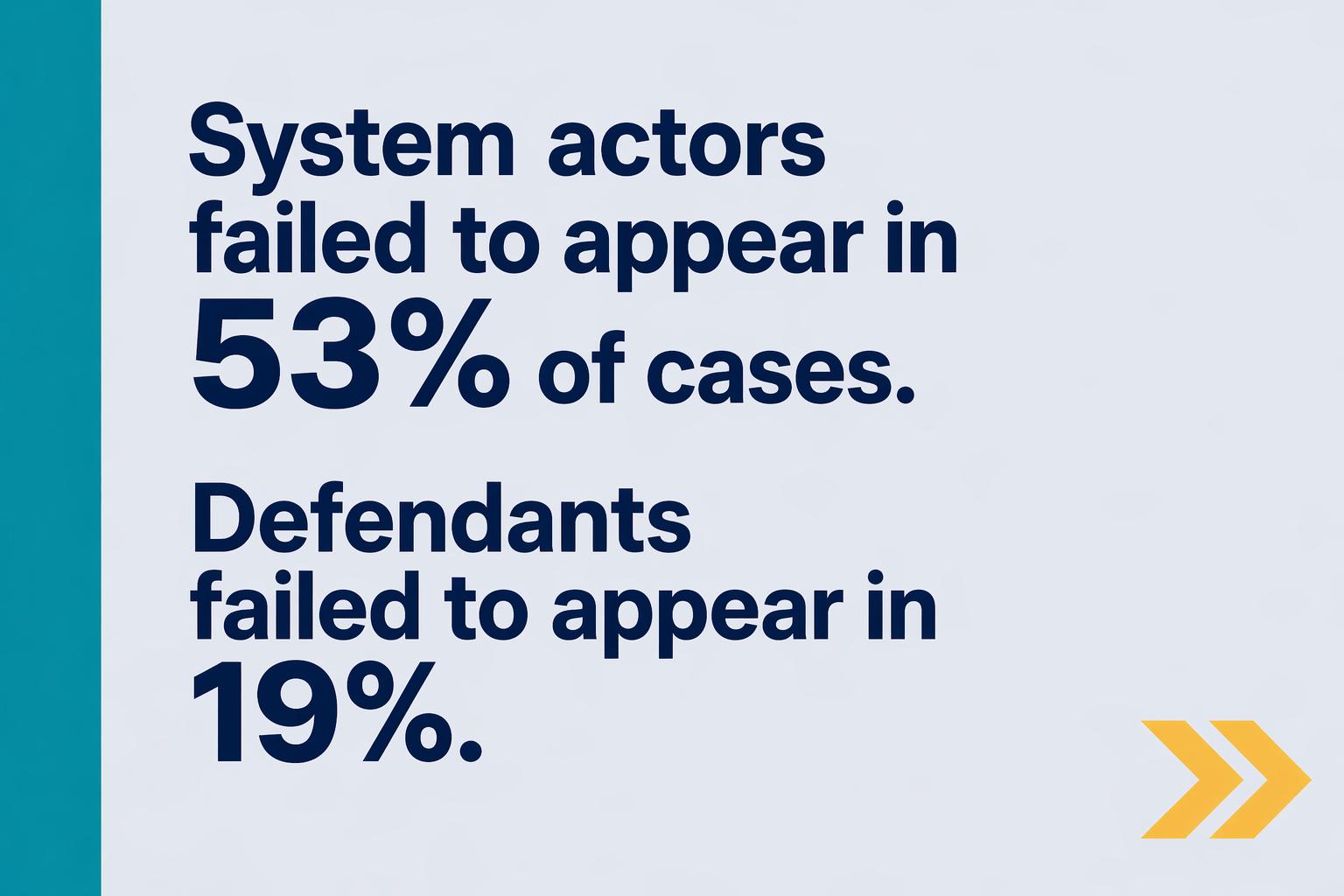
The study examined 341,417 criminal cases in Philadelphia, spanning a full decade from 2010 to 2020, and found that system actors, meaning law enforcement officers, victims, and witnesses, failed to appear in 53% of cases. The defendant’s non-appearance rate over the same period was 19%.
Read that again. The people the system holds in contempt, issues warrants for, and sometimes jails for missing court, appeared at a dramatically higher rate than the professionals and parties whose presence the system largely takes for granted.
Breaking it down further: police officers missed at least one scheduled hearing in 31% of cases in which they were subpoenaed. Victims failed to appear in 47% of cases overall, with the rate rising to 69% in domestic violence cases. Private defense attorneys missed hearings in 36% of cases.
The consequences were not abstract. The study estimated that non-appearance by officers, victims, and witnesses led to about 32,000 case dismissals over the decade studied. When any witness failed to appear, the predicted dismissal rate jumped from 25% to 57%. The system did not collapse because the defendants were absent. It collapsed because everyone else was.
The research, conducted by Lindsay Graef, Sandra G. Mayson, Aurelie Ouss, and Megan Stevenson, was published in the University of Pennsylvania Law Review in 2024. It is the most comprehensive empirical study of court non-appearance ever published and fundamentally changes what we know about who fails to show up.
The asymmetry no one talks about
When a defendant misses a court date, the legal machinery kicks into gear immediately. A bench warrant is issued. Bail may be forfeited. A new criminal charge is possible in most states. In some jurisdictions, a missed court date is a strict liability offense, meaning intent does not matter.
When a police officer misses a court date, typically nothing happens. No warrant is issued. No charge is filed. In most jurisdictions, there is no formal tracking. As one of the study’s authors noted in a subsequent interview, "there isn't currently a way to track officer FTAs, so there's no way to enforce court attendance."
This is not an argument that officers should face bench warrants. The point is narrower and more operational. A system that responds to one category of non-appearance with immediate coercive enforcement while treating another category as invisible has not solved the problem. It has solved only part of it, and not the largest part.
The National Center for State Courts has documented the downstream consequences: missed appearances extend case timelines, increase staff workload, multiply hearings that should not occur, and drive up case costs for everyone. When any party fails to appear, every party that did show up absorbs the cost. The judge was prepared. The clerk pulled the file. The prosecutor was ready. The prosecutor was ready. The defendant arranged transportation, took time off work, and arranged childcare. ideas42 estimates that a missed court date costs approximately $1,496 in direct and indirect expenditures. That figure does not change based on whose absence caused the reset.
When no tracking exists, no one knows what is happening
The Philadelphia study is the most rigorous data available on this topic. As far as researchers have been able to determine, it is also essentially the only rigorous data available. No other U.S. jurisdiction systematically tracks whether officers and witnesses appear in court.
The Albuquerque DWI corruption scandal illustrates what fills that vacuum. A federal investigation found that an attorney had been paying officers to intentionally miss court dates for about 30 years, causing cases to exceed the speedy trial deadline and be dismissed. At least eight officers ultimately pleaded guilty to federal conspiracy charges. Roughly 306 DWI cases were dismissed, and about 10% of those drivers were later re-arrested for DWI. The scheme went undetected for three decades, in part because there was no systematic tracking of officer court appearances.
You cannot manage what you cannot measure.
The cost of officer court time runs into the tens of millions
While non-appearance data is scarce, the financial cost of officer court time is well-documented in municipal audits. Houston PD spent $74 million on overtime in FY 2025, driven largely by officers working afternoon and evening shifts who appear in court the following morning. A new union contract doubled the minimum court overtime guarantee from 2 to 4 hours, so officers receive 4 hours of overtime pay regardless of how long the appearance lasts.
That is the cost of getting officers to court. The cost of a wasted appearance, one in which the case is continued or resolved before the officer is needed, is harder to calculate but no less real. It is also the dynamic most likely to erode officers' willingness to treat court dates as a priority, a pattern practitioners recognized long before any study quantified it.
The operational argument
Courts need every required party present for justice to proceed. When a defendant fails to appear, the case cannot move forward. When an officer fails to appear, the case frequently cannot move forward either. The consequences for the defendant are more immediate and more severe. But the operational outcome is the same.
In 2025, the Fair and Just Prosecution initiative put it plainly: the false narrative about failure to appear has historically focused on defendants. The data now shows that the narrative is incomplete. The problem is systemic, and a systemic problem requires a systemic response.
That means tracking who shows up and who does not across all parties. It means building notification and scheduling infrastructure to serve officers, witnesses, and defendants. And it means treating court appearance as a communication and coordination problem for everyone in the process, not just the person with the most to lose.
Justice delayed is justice denied. The delay does not care who caused it.

Schedule a demo Watch the video
Sources
- Graef, L., Mayson, S.G., Ouss, A., & Stevenson, M. (2024). Systemic Failure to Appear in Court. University of Pennsylvania Law Review, 172(1). https://scholarship.law.upenn.edu/penn_law_review/vol172/iss1/1/
- Penn Carey Law. (2024). Court No-Shows: A Systemic Issue. https://www.law.upenn.edu/live/news/16948-court-no-shows-a-systemic-issue
- Penn Carey Law. (2024). Officers' Failure to Appear in Court Undermines Justice. https://www.law.upenn.edu/live/news/16807-officers-failure-to-appear-in-court-undermines
- Advancing Pretrial Policy and Research. (2024). Showing Up for Court. https://www.advancingpretrial.org/story/showing-up-for-court/
- Fair and Just Prosecution. (2025, March). Shifting the Narrative: How Research Challenges Assumptions About Failure to Appear in Court, and the Need for More Data. https://fairandjustprosecution.org/2025/03/shifting-the-narrative-how-research-challenges-assumptions-about-failure-to-appear-in-court-and-the-need-for-more-data/
- National Center for State Courts. (2026). Missing In Actions: How Low Appearance Rates Impact Courts. https://www.ncsc.org/resources-courts/how-low-appearance-rates-impact-courts
- ideas42. (2024). Stamping Out Missed Court Dates. https://www.ideas42.org/project/stamping-out-missed-court-dates/
- Police1. (2025). Houston PD Overtime Hits $74M, Driven by Traffic Enforcement and Court Demands. https://www.police1.com/law-enforcement-policies/houston-pd-overtime-hits-74m-driven-by-traffic-enforcement-and-court-demands
- KRQE News 13. (2025). DWI Dismissal Scandal: 306 Drunk Driving Cases Dropped. Did the Drivers Reoffend? https://www.krqe.com/news/investigations/dwi-dismissal-scandal-306-drunk-driving-cases-dropped-did-the-drivers-reoffend/
- Criminal Legal News. (2025, March 15). Shakedown in New Mexico: Decades-Long Police Corruption Scandal Rocks Albuquerque's DWI Unit. https://www.criminallegalnews.org/news/2025/mar/15/shakedown-new-mexico-decades-long-police-corruption-scandal-rocks-albuquerques-dwi-unit/