
In May 2026, I had the privilege of presenting at the American Jail Association’s 45th Annual Conference in Milwaukee with Tarrant County Sheriff Bill Waybourn. Sheriff Waybourn and I have worked together since 1993, first in Dalworthington Gardens, then for more than two decades at Tarrant County, where I served as Criminal Courts Administrator before my retirement, and now on a national stage through my role at eCourtDate.
We did not go to Milwaukee with a silver bullet. Jail administrators deal with violent crime holds, mental health crises, chronic high-risk offenders, and sentencing backlogs that no text message can fix. We know that. We wanted to make a simpler point: one operational decision at booking can resolve a significant, measurable, and largely overlooked problem.
The session was called “Small Changes, Big Impact.” That title was chosen carefully. What follows is the story behind it.
What We Did in 2018, and Why
When Sheriff Waybourn began enforcing Texas Code of Criminal Procedure 2.18 in January 2018, the Tarrant County jail began taking custody of arrestees earlier in the process. Every projection indicated that jail bookings would increase. The question was where the leverage would be to manage the impact.
The answer was not new legislation. It was not a technology overhaul. It was one operational decision: embed court staff at the jail during intake to collect accurate contact information from everyone entering.
Booking is the one moment every defendant is guaranteed to be present. If you miss it, you are chasing a phone number that no longer works and a mailing address that is three moves out of date. Courts typically collect contact information only from people who have already shown up. That excludes exactly the population that needs reminders most.
Sheriff Waybourn and the Criminal Courts made that decision based on operational instinct and practical need. We weren’t relying on behavioral science research. We were solving a problem in front of us.
What the Data Showed Over Eight Years
The results were measurable and sustained. From 2017 to 2025, court volume in Tarrant County grew 1.5 times, from 174,839 scheduled appearances to 264,383. Over that same period, the warrant issuance rate fell from 9.0% to 2.6%. Total outstanding warrants dropped 54% from their 2021 peak.
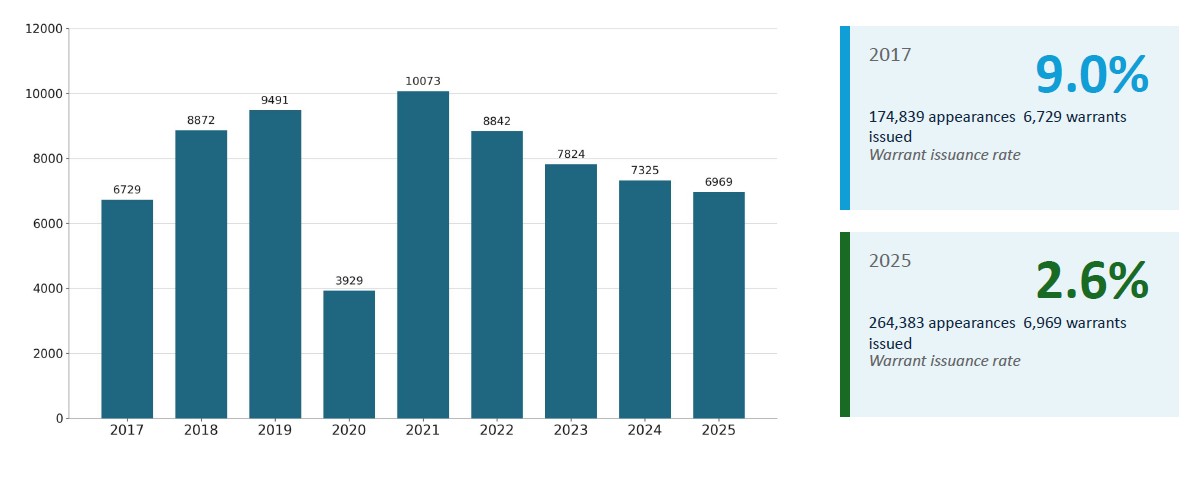
Fewer warrants meant fewer warrant-only arrests, fewer transport runs, less booking churn, and more jail capacity for people who actually needed to be there. Directional modeling based on county data estimates that approximately $975,000 in jail bed costs are avoided annually.
We believed the connection between what changed at intake and what happened to the numbers was real. We would not claim more than the data supported.
How I Came to Understand Why It Worked
After retiring from Tarrant County court administration, I joined eCourtDate. That role introduced me to ideas42, a nonprofit behavioral science organization whose (Un)warranted initiative is dedicated to improving court date communications and reducing unnecessary warrants.
Through that partnership, I came to understand something I had not had language for before. What Tarrant County did in 2018 was not just good operations. It was behavioral design, applied instinctively. The ideas42 research explains why people miss court: not because they are defiant, but because they forget, lose notices, face transportation barriers, or fear what will happen. Thirty-seven percent forgot, according to a 2025 Pew survey. The system decides whether forgetting becomes a warrant. That is a design choice.
This spring, I co-presented with Shannon McAuliffe, National Director of Implementation at ideas42, at the Texas Association for Court Administration’s TAPS conference. Shannon leads court implementation for the (Un)warranted initiative at ideas42, which works directly with courts across the country to redesign court date communications using behavioral science, reducing nonappearance and the warrants that follow. Her recent article in Court Manager, published in November 2025, makes the case directly: courts should design for forgetfulness rather than assume compliance. The title says it all: “Forgetfulness, Not Defiance”.
Presenting alongside Shannon made the AJA session more compelling than I had anticipated. Because I now understand the behavioral science behind Tarrant County’s approach, I can explain it in those terms to an audience of jail administrators. We did something simple, it worked, and now I know why.
What the Tool Looks Like Now
ideas42 has sharpened the tool that Tarrant County began using. The Essential Guide to Court Reminder Programs, published by ideas42 in May 2025, translates behavioral research into operational guidance: automatically enroll; collect contact data at the earliest guaranteed point of contact; clearly frame consequences; prompt plan-making; and reach back out to defendants who miss court before a warrant is issued.
eCourtDate has built those principles into the statewide Texas Court Reminder Program, operated by the Texas Office of Court Administration and available at no cost to every county in the state. Courts that use evidence-based message templates without modification consistently outperform those that customize messages by 5 to 8 percentage points in appearance rates.
The current results speak for themselves. As of May 2026, 34 Texas agencies are live statewide. The program has managed 78,000 court events over 14 months, recording an appearance rate of 87.9%, exceeding the 73% national baseline. It grew from 14 events in December 2024 to 17,622 in January 2026, a 125-times increase in 14 months. Across participating agencies, 4,595 nonappearances have been avoided, representing approximately $6.9 million in avoided government costs at no cost to participating counties.
What Other Jurisdictions Can Take From This
The Tarrant County model is replicable. No new legislation. No major technology overhaul. The leverage points are operational: where is contact information collected, who is responsible for its accuracy, and what happens to it after booking?
The meta-analysis published in Criminology and Public Policy in 2022 found that court date reminders reduce missed appearances in 11 of 12 rigorous studies. The 2020 Fishbane et al. study in Science established a connection between behavioral message design and appearance rates in a large-scale randomized trial in New York City. The 2025 Santa Clara randomized controlled trial found that text reminders alone reduced bench warrants by 20% and pretrial incarceration by 21%.
Only 18 states currently have statewide reminder programs (Pew, 2025). The gap between what the research supports and what most courts are doing is not a technology problem. It is an implementation problem. Booking practice is where implementation begins.
The Point
Sheriff Waybourn made an operational decision in 2018 that turned out to be exactly right. We did not know the research would catch up and confirm it. We did not know that ideas42 would later be able to explain precisely why it worked. We did not know that eCourtDate would carry that model into a statewide program serving 34 agencies across Texas.
We just knew the problem in front of us and made a practical decision to solve it.
We did something simple. It worked. And now I know why. That is a story worth telling.
Sources
Zottola, Samuel A. et al. "Court Date Reminders Reduce Court Nonappearance: A Meta-Analysis." Criminology and Public Policy 22, no. 1 (2022): 97-123. https://doi.org/10.1111/1745-9133.12610
Fishbane, Alissa, Aurelie Ouss, and Anuj K. Shah. "Behavioral Nudges Reduce Failure to Appear for Court." Science 370, no. 6517 (2020). https://doi.org/10.1126/science.abb6591
Chohlas-Wood, Alex et al. “Reducing Pretrial Detention Through Automated Text Reminders." Science Advances (2025). https://www.science.org/doi/10.1126/sciadv.adx7483
Fishbane, Alissa, Shannon McAuliffe, and Yiping Li. "Improving Court Attendance: The Essential Guide to Court Reminder Programs." ideas42, May 2025. https://static1.squarespace.com/static/69a60bc11cc1274bb0e0138e/t/69e150b40687222745c09ce3/1779482372255/Executive-Summar-The-Essential-Guide-to-Court-Reminders-ideas42.pdf
McAuliffe, Shannon, and Nathaniel Mingo. "Forgetfulness, Not Defiance: The Case for Court Reminders." Court Manager, Vol. 39 #4, November 2025.
Pew Charitable Trusts. "States Underuse Court Date Reminders." May 2025. https://www.pew.org/en/research-and-analysis/issue-briefs/2025/05/states-underuse-court-date-reminders
Texas Office of Court Administration. Court Reminder Program. https://www.txcourts.gov/programs-services/court-reminder-program